
Coach’s Corner. Real coaching moments to help you move in your feel-good range.
A new member with a significant leg injury recently joined my class.
He told me he wanted new exercises he can use in his home pool for his “bummed leg.”
His comment reminded me of a conversation I hear often in class.
“Laurie, my hip is weak.”
“My shoulder is my problem.”
“My knee is bad.”
“My leg is crippled.”
But instead of focusing on limitations, I invited the class to try something different.
“What if that body part becomes your pay-attention leg… or arm… or shoulder?”
In other words: Choose your focus—maybe a knee, hip, shoulder, or your back. Let it be your pay-attention part of the body.
Using sensation as feedback
This simple shift connects directly to the Wavemakers philosophy of training by feel. Instead of chasing perfect movement, we use sensation as feedback.
When you allow yourself to feel, the body becomes a place to gather information during the workout.
• On strength days, notice where resistance begins—do you feel it as muscular effort or joint strain?
• During cardio intervals, that awareness helps guide pacing.
• In balance work, it reveals the small adjustments happening in the foot and ankle.
The water environment speeds up learning. The body is supported. Resistance is constant. This combination makes it easier to notice what’s happening in the body.
Recently, while working with my own coach, I learned something else. From a neuroscience perspective, when we repeatedly label a body part as “bad,” “weak,” or “bummed,” we reinforce that pattern in the brain. The negative loop becomes our truth because it is rehearsed again and again.
But awareness and reframing our response can interrupt that negative pattern.
When we pause and shift our language—even something as simple as renaming it the pay-attention leg—we begin creating a different pathway. Over time, the old pattern weakens simply because it is no longer being practiced.
This is training not just for your muscles, but for your brain.
A cue I often repeat in class is simple:
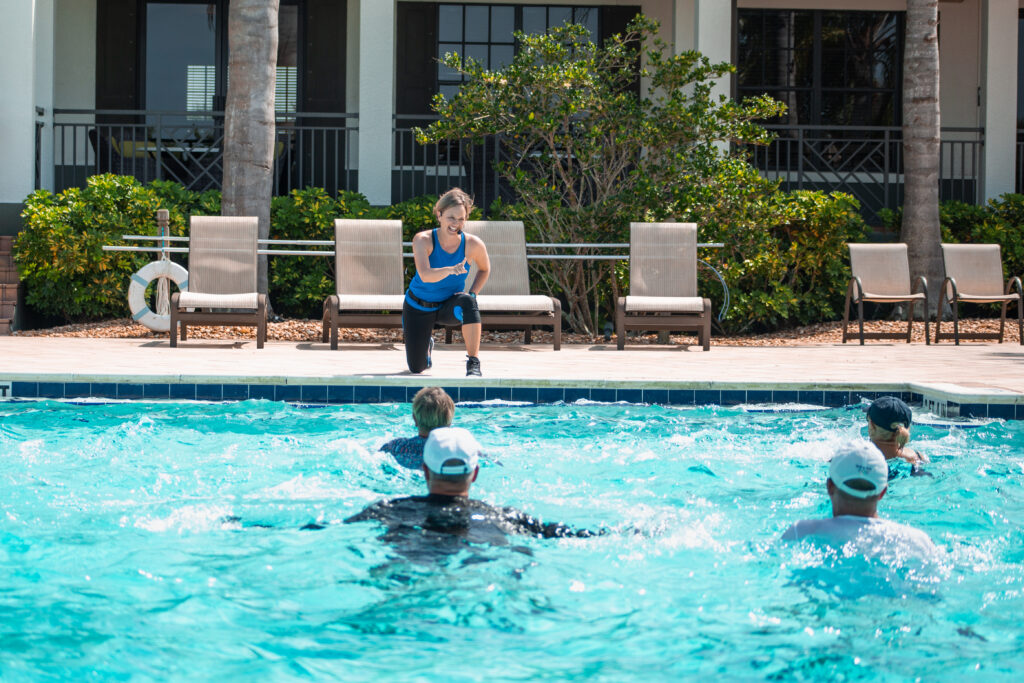
“Move in your feel-good range. Let your body notice what it needs today. Use your pay-attention body part to help guide you toward the movement that works best for you.”
Sometimes the best coaching move isn’t adding more exercises.
It’s helping someone notice something they’ve been feeling all along.
If you teach water exercise…
these are the kinds of cues we develop inside Wavemakers Pro.
Learn how to design workouts that stay simple, but deeply effective.