
Research-backed tips to help you coach water exercise with purpose.
After a challenging water workout, many students are ready to be done. They may start talking, move toward the stairs (to hit the showers first), or rush into the next part of their day.
But the end of the workout is not the end of the training effect.
What happens next matters.
During hard effort, the body shifts into a higher-alert state. Breathing increases. Heart rate rises. Muscles work harder. The nervous system is doing exactly what it should do: helping the body meet the demand.
The problem is that the body does not always shift out of that state when the final set ends.
Supporting research on recovery, breath regulation, and nervous system downshifting shows that intentional breathing can help the body move from a high-effort sympathetic state toward a calmer parasympathetic recovery state. This shift supports heart rate recovery, helps regulate the stress response, and prepares the body for repair and adaptation.
In practical terms, students need to learn how to come down from effort, not just how to push into it.
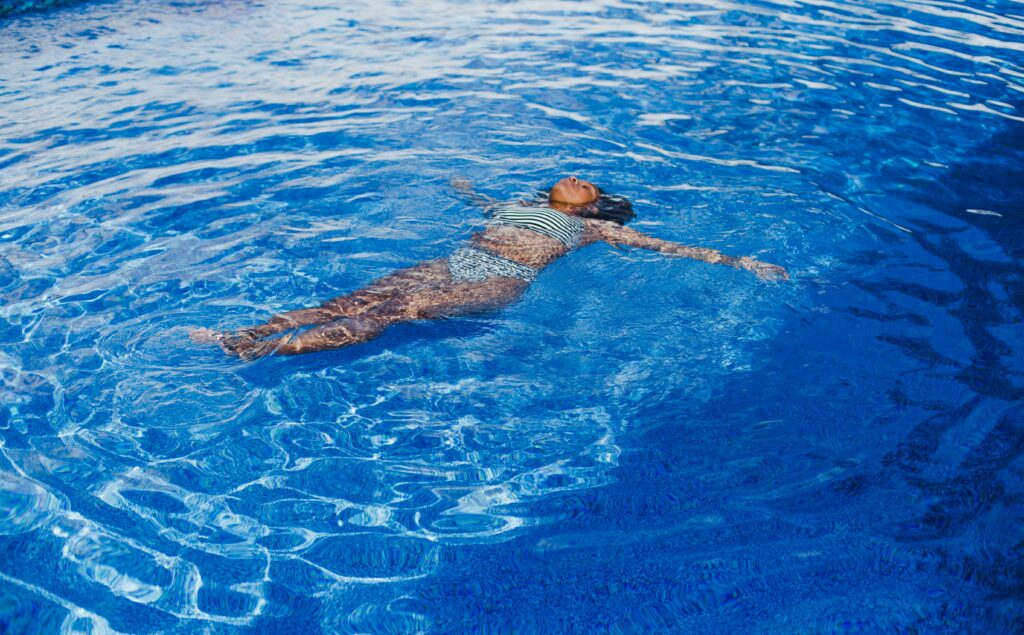
That is where the 3-Minute Brake can help.
The 3-Minute Brake is a short, intentional recovery practice used after the final hard set. It gives students a clear signal: the work is complete, and recovery can begin.
Add this 3-Minute Brake right into your workout so that students don’t miss it.
Start by helping students immerse the body. If they are working in deep water, they are already there. In shallow water, have students widen their stance and lower the shoulders beneath the surface so the body can fully experience the support and pressure of the water.
Then explain why this matters: “The workout creates the challenge, but recovery is when the body begins to rebuild, restore energy, and adapt.” In other words, recovery is not separate from training. It is part of the training.
Next, teach a physiological sigh:
- Inhale deeply through the nose.
- Take a second short inhale.
- Exhale slowly and fully, like blowing out a candle.
Repeat for three minutes.
This simple breathing pattern helps students slow their breath, reduce excess tension, and notice the shift from work toward recovery. It also gives them a practical way to understand that recovery is not something that only happens later.
And this 3-Minute Brake can be fully appreciated and felt in the water helping students to “get it”.
The support of the water and the feedback from hydrostatic pressure and buoyancy make the pool an ideal place to notice breathing, tension, and effort. Students can feel when they are still holding on to the work, and they can feel when the body begins to relax.
Summer is a practical time to reinforce this message.
In warmer weather, students may be more willing to stay in the water for a few extra minutes. Use that opportunity to teach the value of the warm-down.
The warm-down is not just a pleasant ending. It is part of the training effect.
Source Summary: “Post-exercise Parasympathetic Reactivation and Protein Synthesis Signaling” (Journal of Applied Physiology, 2025) and “The Vagal Pivot: New Horizons in Autonomic Recovery” (Sports Medicine Open, 2026).
About the author
Lori Sherlock, is a professor at West Virginia University, exercise physiologist and seven-time Ironman world competitor. Her superpower is getting you results! She coordinates and teaches the aquatic therapy curriculum within the division of Exercise Physiology and is proud to state that it is the only one like it in the nation.
Discover Wavemakers
Inside Wavemakers, we use the pool to make movement feel more doable, more supportive, and more enjoyable.