
Coach’s Corner. Real coaching moments to help you move in your feel-good range.
A student recently came to me with a problem I hear often:
She had lingering back pain every time she worked out at the gym or played a round of golf. She pointed to her midback and said, “I’m weak here. Can we work on strengthening my back?”
It would have been easy to give her more back exercises. But when someone is experiencing pain, one of my first go-to strategies is to strengthen above and below where the pain is felt.
That may sound surprising. If your midback hurts, shouldn’t we work the midback?
Sometimes, yes. But often the painful area is doing too much because other areas aren’t helping enough.
Think of it like a team project. If one person is carrying most of the work, that person gets overloaded. The solution isn’t always to ask that same person to work harder — sometimes the better solution is to get the rest of the team involved.
Your body works the same way.
For this student, that meant working above and below her midback: hips and shoulders.
When the hips and shoulders share more of the work, the midback doesn’t have to work so hard. The hips create power and support from below. The shoulders connect movement from above. Between the two, the core learns how to organize and stabilize the body.
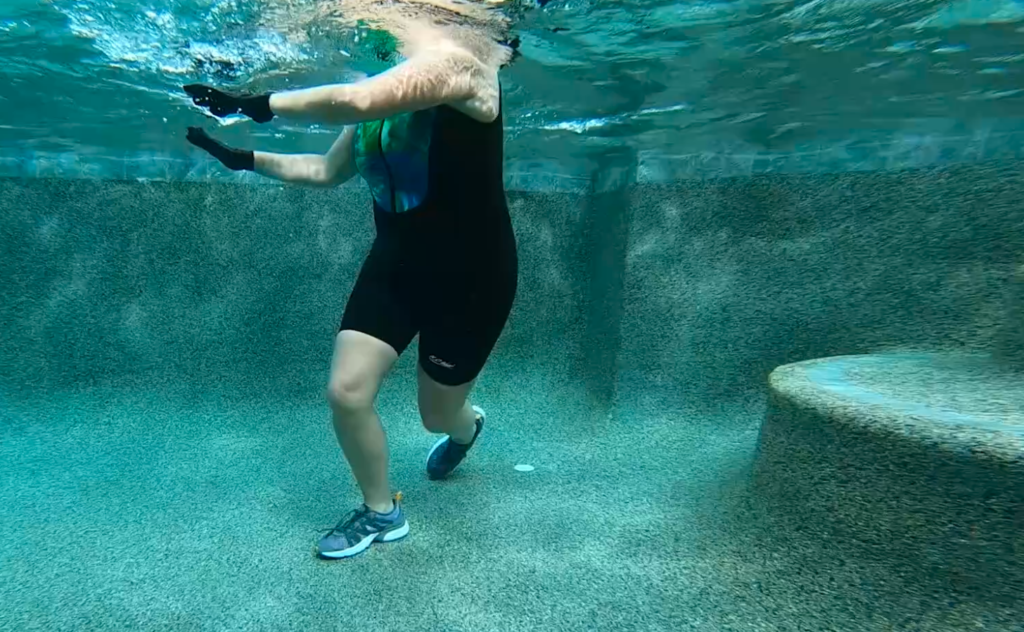
If your back keeps working overtime, the answer may be helping your hips, shoulders, and core work better together.
We started with a simple progression in the water:
- A leg swing to help the hip move more freely.
- A leg press to build strength and help the legs, hips, and core contribute more.
- A hip hinge with a pool noodle. With both hands pressing down on the noodle, the core responds to the upward push of buoyancy — creating tension, support, and stability through the middle of the body. Automatic core engagement.
- A leg swing with hip hinge on diagonals, holding the noodle with one hand.
That final movement is where it becomes really fun.
In this progression, we added new directions, so the movement wasn’t just forward and back. The hips, shoulders, and core had to work together across different planes. More like real life, and much more like golf.
That’s what makes water exercise so powerful. It’s not just about going through the motions. It’s about noticing what changes when you adjust the motion.
After one session, my student told me: “The exercises really helped. I haven’t felt any soreness from that or my gym session afterwards.”
That doesn’t mean one exercise fixes everything, but it does show what can happen when you ask a better question.
Instead of assuming her back was weak, we looked at what her body was trying to tell us. Her midback didn’t need to work harder. It needed more support from the hips, shoulders, and core.
That’s what water exercise can teach you — not just how to do an exercise, but how to notice where you’re gripping, where you’re compensating, and where another part of your body might be ready to help.
Every time you get in the water, you have a chance to stop guessing, listen more closely, and get to know your body a little better.
Want to keep moving, no matter what life throws at you?
Inside Wavemakers, we help you build strength, confidence, and resilience through simple, feel-good water workouts you can adapt to your body, on any day.