
Research-backed tips to help you coach water exercise with purpose.
A build-up drill is one of the easiest ways to help students understand intensity. But it can do more than teach effort. It can also prepare the body and nervous system for the work that comes next. If you are new to build-up drills, start here.
Once students understand the simple progression of easy to moderate to hard, you can use that same tool in another way: to prime the body for better movement.
This idea is called neural priming.
Instead of using the warm-up only to loosen muscles or rehearse movements, neural priming helps wake up the connection between the brain, nerves, and muscles before asking the body to work harder. That matters because students need warm muscles and a ready system to help move with better coordination and feel more prepared for strength, power, balance, or cardio work.
Why This Matters in Water Exercise
In the pool, we often use familiar moves like jogs, skis, jumping jacks, kicks, reaches, and tucks. The move itself may be simple, but the result depends on how the student performs it.
That is where a build-up drill becomes useful.
When students move from easy to moderate to hard, they are not only learning effort. They are also practicing how to recruit more muscle, move more water and stay in control as demand increases.
In other words, the build-up drill becomes a preparation tool. It teaches the body what is coming.
Try This: The 2-Minute Prime
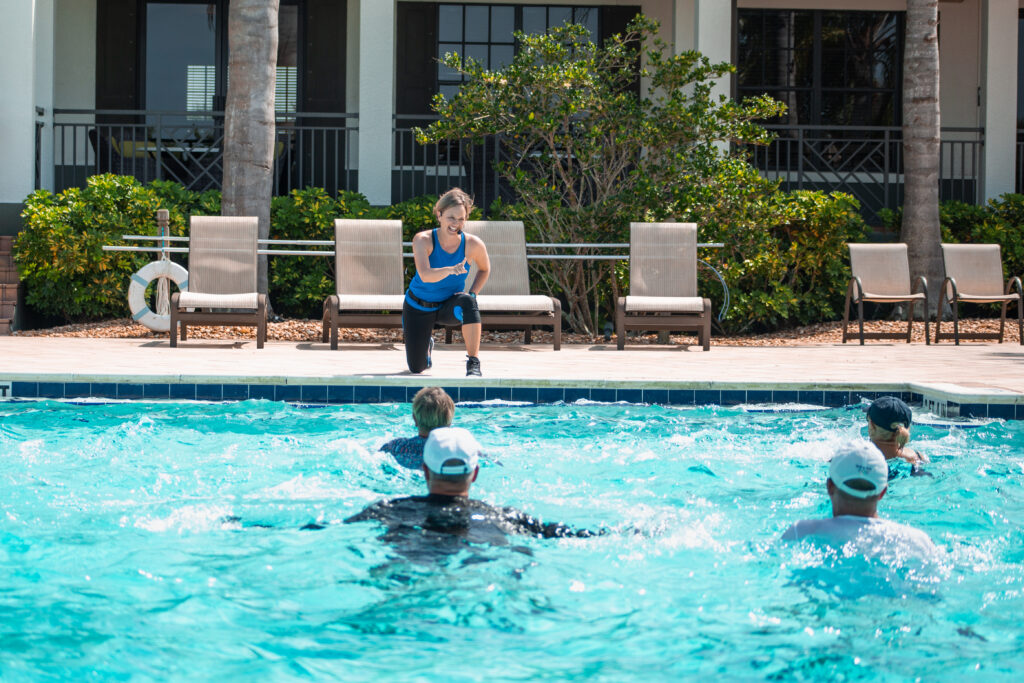
Choose one simple movement that will show up later in class. Examples include jog, ski, jumping jack, tuck, side kick, cross-country ski, or a forward reach and pull.
Start with easy to practice the pattern and feel the water support you. Then build to moderate. Notice the water pushing back and muscles doing more work.
Finally, add a short burst: 1–2 strong, quick, controlled repetitions.
Then back off.
The goal is not to fatigue the body. The goal is to prepare it.
This short prime gives students a preview of the demand without asking them to stay there too long. When the same movement returns later in class, the body has already had a chance to feel the pattern, organize the effort, and prepare for stronger work.
What to Watch For
As students move through the drill, watch for posture, range of motion, breathing and control. A good prime should help students look more focused and ready, not rushed or confused.
If the short burst causes students to lose control, reduce the speed, range, or impact.
If they can create more effort and still stay organized, the prime is doing its job.
Why This Fits the Wavemakers Way
Build-up drills are often used to help students feel the difference between easy, moderate, and hard effort. Neural priming gives us one more reason to use the same tool.
You’re still teaching intensity, but now you’re also helping students prepare for better movement.
That means the warm-up is not just something we do before the workout. It becomes part of the workout’s success.
Try it in your next class
Pick one movement from your main workout and use it in the warm-up as a 2-minute prime.
Move through easy, moderate, and one short powerful burst.
Then bring that same movement back later in class.
Ask students what changed the second time they did it.
That one reflection can help them notice whether they feel more prepared, coordinated, powerful, or in control.
A good build-up drill does more than teach intensity. It helps students feel ready to move with purpose.
Sources: Neuromuscular Potentiation and Force Deficits (JSCR, 2025) and Molecular Mechanisms of PAPE (Sports Medicine Quarterly, 2026).
About the author
Lori Sherlock, is a professor at West Virginia University, exercise physiologist and seven-time Ironman world competitor. Her superpower is getting you results! She coordinates and teaches the aquatic therapy curriculum within the division of Exercise Physiology and is proud to state that it is the only one like it in the nation.
Discover Wavemakers
Inside Wavemakers, we use the pool to make movement feel more doable, more supportive, and more enjoyable.