Body Connections: Helping your body move better together.
Low back pain can be life-changing. This kind of pain affects sitting, standing, almost all movement. But trying to simply stretch or strengthen the back to reduce this pain isn’t a great bet — the real answers are usually found elsewhere. The low back is often just the place that feels the stress when something above or below it isn’t doing its share.
Your low back sits between your pelvis and your upper back. It responds to how your hips move, how your pelvis rotates, how your spine extends, and how well your glutes support you. When your body gets stuck in a forward-flexed position, your low back ends up holding more than it should.
That’s why inside Wavemakers, we don’t train the low back as an isolated body part. We use movements your body already recognizes — walking, stepping, reaching, rotating, shifting — so your hips, pelvis, glutes, core, and upper back learn to share the work.
So instead of “I need one back exercise,” think: “I need to practice the movements that help my back feel supported by my whole body.” Try it by practicing these movements:
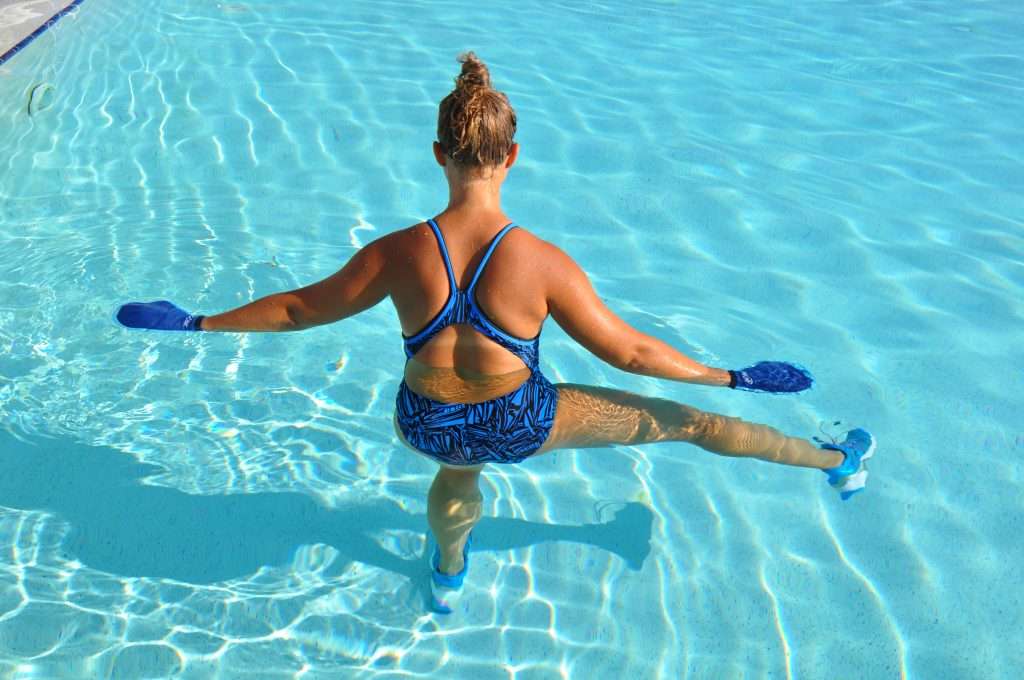
1. Backward Walking: Open the Hips and Lift the Spine
Focus: hip extension, thoracic extension, posture, control
Backward walking in the water is one of the simplest ways to give your body a break from constant forward flexion.
Life pulls us forward — sitting, driving, looking down, reaching in front of us. Walking backward reverses that pattern.
As you step back, the front of your hip lengthens. Your spine naturally lifts. Your upper back gets a chance to extend instead of rounding forward. Sharing the movement with your hips and upper spine — instead of asking the low back to handle it alone — is exactly what takes the strain off.
Try this focus: Step back with control. Keep shoulders over hips. Feel the front of the hip open.
2. Pelvis-Led Rotation: Let the Belly Button Lead
Focus: pelvis movement, spinal rotation, core connection, control
Many people rotate by forcing the spine to do all the work. But your pelvis can start the motion instead. One helpful cue: let your belly button lead.
Ground your feet, then gently turn your pelvis to one side and let the upper body follow — imagine your belly button moving from 3 to 9 o’clock on a clock face. Keep your shoulders stacked over your hips, so the rotation shows up more in the hips than the low back.
The low back doesn’t like being the only place movement happens. When the pelvis leads, motion travels through the body instead of getting stuck in one spot.
Try this focus: Let your belly button lead. Notice shoulders stay over hips. Keep the motion one speed.
3. Hip Extension with Reach: Connect the Glutes, Hips, and Upper Back
Focus: hip extension, glute support, arm reach, whole-body length
Start with one foot slightly behind you. Press gently through that back foot and feel the hip open.
Now add a reach — one or both arms forward toward the water’s surface, or overhead, whatever feels best in your body.
The reach changes what happens through your ribs, spine, core, and pelvis: the back leg opens the hip, the arms create length through the upper body. That whole-body length is the point — your low back isn’t meant to do all the lifting, holding, and extending on its own.
Try this focus: Step one foot back. Press into the back toe. Feel the hip open. Add a gentle reach and notice how your hips and spine share the movement.
The Wavemakers Way
Helping your low back starts with more than your low back. Your hips, pelvis, glutes, core, and upper back all help share the work.
Backward walking, pelvis-led rotation, and hip extension with reach can become low-back-support training once you know what to feel.
Inside Wavemakers, simple cues turn everyday water exercises into strength, mobility, balance, core support, and better movement.
About the author
Jeanmarie Scordino has over 25 years of experience as an exercise physiologist, personal trainer, sport conditioning coach, and clinical health coach. As Fellow of Applied Functional Science, she is dedicated to education and helping people move better and perform at their best.