Body Connections: Helping your body move better together.
When people ask me about pelvic floor exercises, they’re often looking for one specific exercise. Usually, they’ve heard about Kegels.
But your pelvic floor isn’t just something to tighten. It needs to lengthen, load, and respond as you move. That means we have to train it in motion.
Your pelvic floor is connected to your feet, hips, pelvis, core, breath, and upper body. Where your feet go changes what happens at your hips. What happens at your hips changes what happens at your pelvis. And when you add arm reach or rotation, you create even more connection through the ribs, core, and pelvic floor.
So instead of asking, “What is the best pelvic floor exercise?” try asking, “How can I use movement to help my pelvic floor respond better?”
That’s the real focus: using your feet, hips, pelvis, breath, and upper body to create the connection.
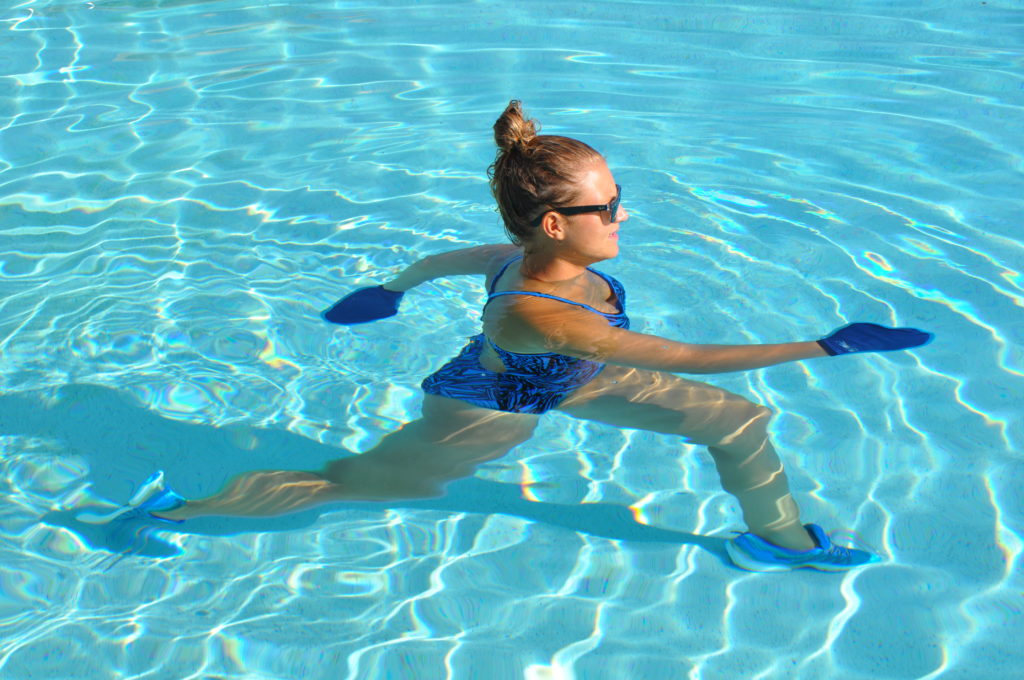
1. Wide Cross Country Ski: Create Length Through the Pelvis
Focus: wide foot position, hip motion, pelvic floor lengthening, and control
A wide cross country ski is a simple way to help the pelvic floor lengthen.
Take your feet wider than your usual ski. The width is the important part. When your legs move farther apart, your hips and pelvis experience more tension. That tension helps create length through the pelvic floor.
Why does that matter? The pelvic floor doesn’t only need to contract. It needs to lengthen so it can respond well. A wider ski gives your body a way to feel that length while you’re standing, moving, and supported by the water.
Try this focus: Widen your ski. Feel the gentle pull through the hips and pelvis. Keep your breath steady and your movement controlled.
2. 5 Dot Drill: Teach the Pelvic Floor to Respond to Changing Foot Positions
Focus: foot placement, hip control, pelvic floor loading, and upper-body stability
Imagine five dots on the pool floor, like the five dots on a die.
Move your feet wide, narrow, wide — first in front of your body, then under your body, then behind your body. Each position changes where your feet land and how your hips and pelvis have to respond.
This matters for the pelvic floor because it doesn’t work in one fixed position. It has to respond when your feet are wide, narrow, forward, underneath you, and behind you. Each change in foot position creates a different pull through the hips and pelvis.
Try this focus: Move wide, narrow, wide across the dots. Notice how each foot position changes what you feel through your hips, pelvis, and core.
3. Lunge with Alligator Arms: Use Rotation to Wind Up the Hips and Pelvis
Focus: lunge position, arm reach, hip wind-up, and whole-body connection
Start in a comfortable lunge position with one foot forward and one foot back.
Reach both arms out to the sides and feel the length from your right hand to your left hand. Keep your feet grounded and your body tall.
This already matters for the pelvic floor because your feet are split, your hips are lengthened, and your pelvis has to stabilize your position.
Now bring your hands together over the front leg, like the mouth of an alligator closing. As your hands clap on the outside of the front leg, allow your upper body to rotate.
The hands guide the rotation, but the motion should travel through your ribs, core, hips, pelvis, and pelvic floor. That rotation helps “wind up” the hips and pelvis, creating a whole-body pull rather than an isolated squeeze.
Try this focus: Hold the lunge. Reach wide from hand to hand. Then clap your hands over the front leg and feel the rotation travel through your upper body, hips, and pelvis.
The Wavemakers Way
Helping your pelvic floor starts with more than your pelvic floor. Your feet, hips, glutes, core, breath, posture, arms, and rotation all help it respond.
A wide ski, 5 dot drill, or lunge with alligator arms can become pelvic-floor-support training. Once you can feel the connection, add speed — because the pelvic floor doesn’t only need to respond when you move slowly. It also needs to respond quickly, when you step, turn, react, laugh, sneeze, or change direction.
Inside Wavemakers, simple cues help you turn everyday water exercises into strength, mobility, balance, core support, and better movement.
About the author
Jeanmarie Scordino has over 25 years of experience as an exercise physiologist, personal trainer, sport conditioning coach, and clinical health coach. As Fellow of Applied Functional Science, she is dedicated to education and helping people move better and perform at their best.