
If you’re dealing with knee pain, the pool is one of the best places you can be.
The water reduces the load on your joints while still giving your muscles real resistance to work against. You can move freely, build strength, and feel good doing it, without the impact that makes land-based exercise feel like a gamble.
Most people know that. What’s less talked about is how to structure that time in the pool so your knees actually get stronger, not just less sore for a day or two.
The Problem with Back-to-Back Cardio
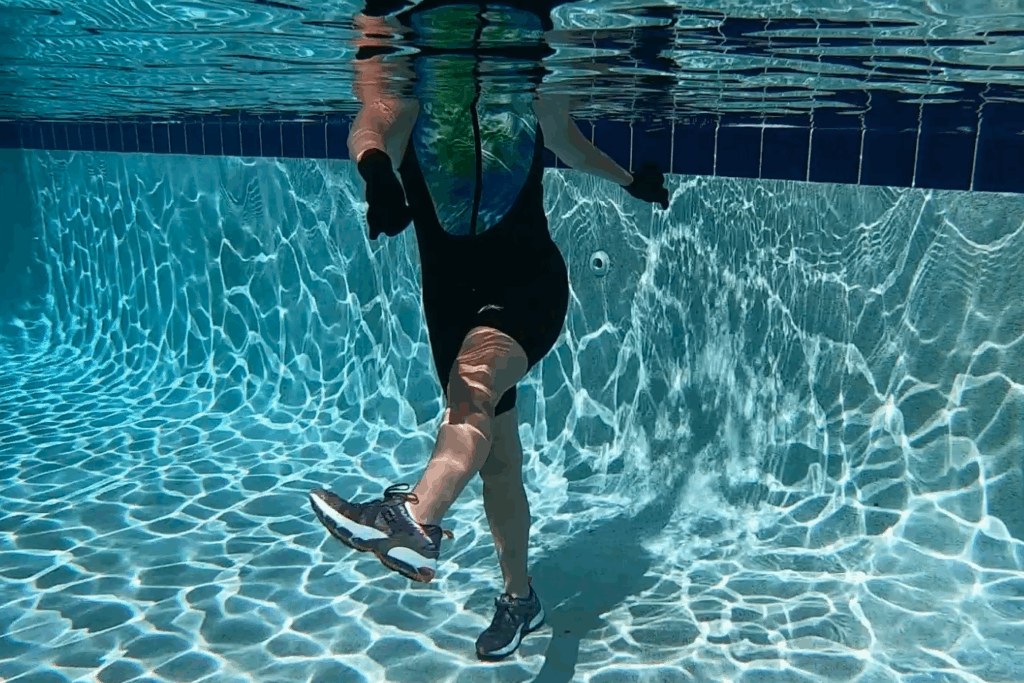
Pool cardio is great. It challenges your muscles, builds endurance, and gets your heart rate up in a way that feels manageable even on a hard day.
But here’s what happens when cardio is the whole plan: fatigue builds, and tired bodies take shortcuts.
The hips start doing less. The knee starts absorbing more load than it should. Movements get tighter and smaller and less controlled. And that’s usually right around when discomfort shows up.
It’s also when the gap between your stronger and weaker muscles gets bigger, because your body keeps leaning on what it already knows instead of building what it’s missing.
What Actually Helps Build Knee Strength
Stronger knees don’t come from pushing harder. They come from moving better, especially when your body is tired and tempted to compensate.
The approach that works: instead of running one effort straight into the next, you insert short functional movement sets between your cardio rounds. These aren’t rest breaks and they’re not random stretching. They’re targeted patterns that help your body reset so the next round of work is built on better movement.
Your legs will work more evenly, and your knees will be better supported.
Start at the Hips
The knee sits between the hip and the foot. So if you want to improve knee function, those are the two places to focus.
This drill sequence is designed to wake up the hips first, so when you go back to cardio, they’re ready to contribute instead of check out:
- Leg swings
- Leg swings with a hip hinge
- Lunge stance with a single-arm rotation reach
Then you add the intensity — staggered stance tuck jumps — but now you’re loading a body that’s actually prepared to handle it.
See It in Action
I walk through this exact drill sequence in the video below — leg swings, the hip hinge, the rotation reach, and the tuck jumps that follow. It’s a clear example of what a Wavemakers workout actually looks like: purposeful movement that trains your body to work better, not just harder.
Why This Helps Knee Pain
When the hips and feet are doing their share of the work, the knee doesn’t have to compensate. That’s the goal.
These short functional sets reconnect hip movement, improve control through the foot and ankle, and restore your posture before intensity increases again. In the water, you also get the bonus of buoyancy — joint support that lets you move through a fuller range of motion with less risk.
The result is a workout that builds real strength, not just temporary relief.
The Takeaway
If you want stronger knees, don’t just focus on intensity, but on how your body organizes movement between effort.
This is where control improves, and where the stress on your knees decrease. And this is what allows you to keep building strength.
If this way of training resonates with you, it’s what every class at Wavemakers is built around. Come try one and feel the difference.